

- seo
- October 1, 2026
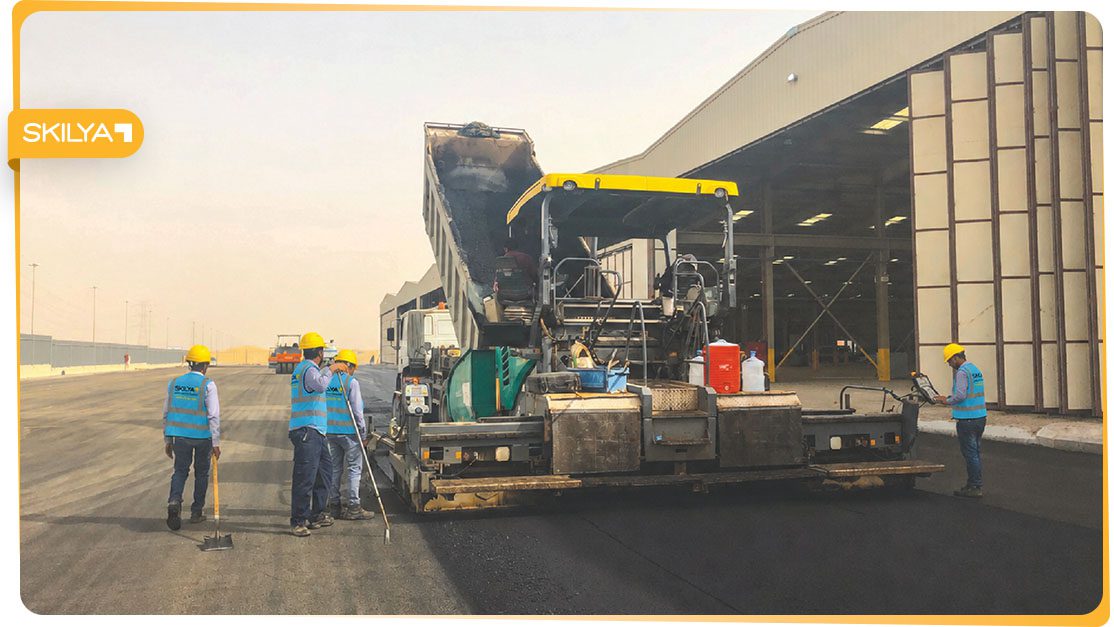
Skilya Infrastructure and Road Construction Services
A construction project does not begin and end with the building itself. Factories, warehouses, commercial developments, residential compounds, educational facilities, and industrial sites all depend on infrastructure that allows people, vehicles, utilities, and operations to move efficiently across the development.
Roads provide access. Earthworks prepare the site. Water networks connect facilities with essential utilities. Drainage and dewatering help manage ground and surface water. External infrastructure connects individual buildings with the wider site.
For this reason, infrastructure should be planned as an integral part of construction rather than treated as secondary work completed after the main building.
Skilya Infrastructure and Road Construction Services bring together earthworks, road construction, water networks, dewatering, and site-development requirements within a coordinated construction approach. Skilya currently lists Earthwork Construction, Water Networks, Road Construction, and Dewatering among its core Infrastructure capabilities.
By connecting these activities with building construction, MEP, structural works, logistics, and project management, Skilya can support the development of complete project sites rather than isolated structures.
What Are Infrastructure Construction Services?
Infrastructure construction covers the physical systems and external works that enable a development to function.
Depending on project scope, infrastructure can include:
- Earthworks
- Excavation
- Backfilling
- Grading
- Soil preparation
- Dewatering
- Internal roads
- Access roads
- Pavement works
- Water networks
- Drainage
- Underground utilities
- Parking areas
- Site development
These systems create the connection between the building and its surrounding environment.
A factory may be structurally complete, but it cannot operate effectively if trucks cannot access loading areas.
A warehouse needs external roads capable of supporting repeated heavy vehicle movement.
A residential development depends on internal roads, utilities, drainage, and pedestrian circulation.
Infrastructure therefore has a direct effect on long-term project functionality.
Why Infrastructure Planning Should Begin Early
One of the most common mistakes in project delivery is considering infrastructure too late.
External works are deeply connected with the rest of the construction project.
Road levels can affect building entrances.
Underground utility routes can conflict with foundations.
Drainage levels depend on site grading.
Loading areas need to coordinate with warehouse floor elevations.
Water networks need to connect with building plumbing and fire systems.
When these requirements are evaluated early, construction teams can develop a more coordinated site plan.
Late infrastructure decisions can create excavation near completed works, utility conflicts, pavement modifications, and unnecessary rework.
This is why integrated infrastructure planning begins alongside the main construction strategy.
Earthworks: The Foundation of Site Development
Before many roads, buildings, parking areas, or external networks can be constructed, the site needs to be prepared.
Earthworks can include:
- Site clearing
- Excavation
- Cutting
- Filling
- Backfilling
- Grading
- Soil removal
- Embankment construction
- Subgrade preparation
- Soil stabilization
The objective is to create suitable levels and ground conditions for the next construction stages.
Skilya’s existing earthwork capabilities include excavation and backfilling, grading, subgrade and base preparation, site clearing, cut-and-fill activities, soil stabilization, and infrastructure site development.
Earthwork quality is critical because every layer constructed above the ground depends on the stability beneath it.
Understanding Cut and Fill
Many construction sites do not initially have the required final levels.
Some areas may be too high and need excavation, while others need additional fill material.
Cut-and-fill planning helps redistribute soil across the site and establish the required elevations.
This process can influence:
- Road levels
- Building pads
- Drainage
- Parking areas
- Utility routes
- Material quantities
Good earthwork planning can also reduce unnecessary material transportation.
The objective is not simply to move soil, but to create stable and coordinated site levels that support the entire development.
Subgrade Preparation
Roads and paved areas depend heavily on the condition of the subgrade beneath them.
The subgrade is the prepared soil layer supporting subsequent pavement layers.
If the ground is weak, poorly compacted, or inconsistent, pavement performance can suffer.
Potential problems can include:
- Settlement
- Cracking
- Rutting
- Surface deformation
- Uneven pavement
Road construction therefore begins below the visible asphalt.
Subgrade preparation can involve excavation, grading, compaction, replacement of unsuitable material, or stabilization depending on site conditions.
Skilya’s current road-construction content similarly emphasizes earthworks, subgrade evaluation, drainage, and pavement preparation before final road layers are installed.
Dewatering in Infrastructure Projects
Groundwater can create significant challenges during excavation and civil construction.
If water accumulates in excavations, it can interfere with:
- Foundation works
- Utility installations
- Soil compaction
- Excavation stability
- Road construction
- Underground networks
Dewatering helps create workable site conditions where groundwater or accumulated water would otherwise disrupt construction.
The selected approach depends on site conditions and the depth and nature of the excavation.
Dewatering should also be coordinated carefully with earthworks and other civil activities because water conditions can affect soil performance.
Skilya includes Dewatering among its listed infrastructure capabilities.
Road Construction as Part of Site Infrastructure
Roads connect every part of a developed site.
They can provide access for:
- Employees
- Visitors
- Trucks
- Construction vehicles
- Emergency services
- Material deliveries
- Maintenance teams
Industrial and logistics developments can place particularly demanding loads on roads.
Repeated heavy trucks can create pavement stresses that differ significantly from those caused by normal passenger vehicles.
The road therefore needs to be developed according to its expected use.
Road Construction Starts With Traffic Requirements
Before determining pavement requirements, project teams need to understand the vehicles that will use the road.
Important considerations include:
- Vehicle type
- Traffic frequency
- Heavy truck movement
- Axle loads
- Turning movements
- Loading areas
- Expected operational life
An internal industrial road serving heavy trucks should not necessarily be constructed to the same requirements as a light-access road.
Skilya’s existing content on industrial and internal roads similarly emphasizes traffic loads, axle requirements, turning movements, earthworks, and heavy-duty subbase construction.
Road Construction Layers
A road is not simply a layer of asphalt placed over soil.
Its performance depends on several underlying layers working together.
A typical road structure may involve:
Prepared Subgrade
The compacted ground supporting the pavement structure.
Subbase
A structural layer helping distribute loads and create a stable platform.
Base Course
A stronger pavement layer providing additional load distribution.
Asphalt or Final Pavement Surface
The upper layer carrying traffic and providing the driving surface.
The exact design depends on engineering requirements, traffic, materials, site conditions, and the intended road use.
Failure in lower layers can eventually appear as visible pavement defects.
This is why road quality starts long before asphalt placement.
Compaction and Road Performance
Compaction is one of the most important activities in earthwork and road construction.
Properly compacted soil and pavement layers help increase stability and reduce future settlement.
Poor compaction can contribute to:
- Depressions
- Pavement cracking
- Uneven surfaces
- Structural failure
- Premature maintenance
Each layer therefore needs to be prepared and compacted according to project requirements before subsequent layers are placed.
Quality-control testing can help confirm whether the required density has been achieved.
Drainage and Road Durability
Water is one of the major factors affecting road performance.
If water enters pavement layers or remains trapped beneath the road, it can weaken supporting materials.
Road planning should therefore consider drainage from the beginning.
This may involve:
- Surface slopes
- Stormwater drainage
- Channels
- Underground drainage
- Culverts
- Subsoil drainage
- Site grading
Roads, drainage, and surrounding levels need to work together.
Constructing a strong pavement without addressing water movement can reduce the long-term performance of the entire system.
Internal Roads for Industrial Sites
Industrial developments often require extensive internal road networks.
These roads may connect:
- Main entrances
- Factories
- Warehouses
- Loading bays
- Truck yards
- Parking
- Administrative buildings
- Utility areas
Industrial roads need to accommodate operational traffic rather than simply provide basic vehicle access.
Turning radii, pavement strength, road width, traffic separation, loading movements, and drainage all need to reflect the facility’s operational requirements.
For factories and logistics facilities, road construction therefore becomes part of the industrial process.
Roads for Warehouses and Logistics Facilities
Logistics developments depend heavily on vehicle movement.
Trucks may enter the site throughout the day, travel through internal circulation routes, wait in designated areas, maneuver into dock positions, and exit after loading or unloading.
The site layout should support these movements safely and efficiently.
Road and pavement construction should therefore coordinate with:
- Loading bays
- Truck yards
- Warehouse floor levels
- Gate locations
- Security points
- Parking
- Drainage
- Pedestrian routes
Skilya’s warehouse-construction content already highlights the relationship between heavy-duty roads, loading areas, drainage, water networks, external lighting, and utility connections.
Water Networks
Water networks form another important part of external infrastructure.
Depending on project requirements, water systems can support:
- Domestic water
- Industrial use
- Irrigation
- Firefighting
- Cleaning
- Building utilities
Network planning needs to consider:
- Pipe routing
- Connection points
- Pressure requirements
- Valves
- Building interfaces
- Underground conflicts
- Future maintenance
Water networks frequently share underground corridors with electrical, drainage, and communication services.
Coordination is therefore essential.
Once roads and paved areas are complete, modifying buried networks becomes much more disruptive.
Underground utilities should be planned before final road construction wherever possible.
Underground Utility Coordination
One of the biggest infrastructure challenges is managing several underground systems within the same site.
These can include:
- Water
- Drainage
- Electrical cables
- Fire networks
- Communication networks
- Other utilities
Each system requires appropriate levels, routes, clearances, and access points.
Poor coordination can create physical clashes.
It can also create maintenance difficulties after project completion.
Infrastructure drawings and site coordination should therefore identify how networks cross and interact before excavation begins.
Infrastructure for Industrial Projects
Industrial facilities require infrastructure that supports production and logistics.
A factory site may need:
- Heavy-duty internal roads
- Truck access
- Water networks
- Fire networks
- Utility corridors
- Drainage
- Equipment access
- Loading areas
- Parking
Infrastructure needs to respond to industrial operations.
For example, a road may need to support heavy trucks transporting raw materials.
Water networks may need to serve both building systems and industrial processes.
Utility routes may need to connect specialized equipment.
The infrastructure package therefore needs to coordinate with the operating model of the facility.
Infrastructure for Commercial Developments
Commercial projects introduce different requirements.
Infrastructure may need to support:
- Customer vehicles
- Employees
- Parking
- Pedestrian routes
- Service vehicles
- Building utilities
- Landscaping
- Drainage
The appearance of external areas may also be particularly important.
Roads, sidewalks, parking areas, landscaping, and entrances form part of the user’s first experience of a commercial development.
Construction quality therefore needs to address both technical performance and the final appearance of the site.
Infrastructure for Residential Developments
Residential compounds and multi-building projects depend heavily on external infrastructure.
Typical requirements can include:
- Internal streets
- Water networks
- Drainage
- Parking
- Walkways
- Utilities
- Landscaping
- External lighting
The infrastructure needs to create a practical living environment around the buildings.
Road layouts affect traffic.
Drainage affects site performance.
Pedestrian routes influence accessibility and safety.
Infrastructure therefore directly contributes to residential quality.
Site Access During Construction
Infrastructure is not only important after project completion.
Temporary and permanent roads can also influence the construction process itself.
Construction teams need access for:
- Heavy equipment
- Cranes
- Trucks
- Material deliveries
- Workers
- Emergency vehicles
Poor access can reduce site productivity.
Infrastructure planning may therefore need to consider which roads or site areas should be developed early enough to support construction logistics.
This can be especially important on large industrial sites.
Infrastructure and MEP Coordination
External infrastructure and building services connect at multiple points.
A water network connects to the internal plumbing system.
Electrical infrastructure feeds building electrical systems.
Fire networks connect with pumps and internal firefighting systems.
Drainage systems connect internal and external water management.
Infrastructure planning should therefore coordinate closely with MEP teams.
This relationship helps ensure that connection points, levels, capacities, and routes work together.
Infrastructure and Building Levels
Building elevation affects the infrastructure surrounding it.
Road levels need to connect correctly with entrances.
Loading bays need suitable pavement levels.
Drainage needs sufficient slope.
Parking areas need proper grading.
Incorrect level coordination can create difficult problems after construction.
A road built too high or too low relative to a building entrance can affect accessibility and drainage.
For this reason, survey information and project levels need careful control throughout site development.
Quality Control in Infrastructure Construction
Infrastructure works often become hidden beneath finished surfaces.
This makes progressive inspection especially important.
Quality control can cover:
- Excavation levels
- Soil conditions
- Compaction
- Subgrade
- Utility installation
- Pipe testing
- Backfilling
- Pavement layers
- Asphalt
- Road levels
- Drainage
Underground networks should be inspected and documented before trenches are closed.
Road layers should be checked before later layers cover them.
Skilya’s current closeout guidance also identifies water networks, drainage networks, underground utilities, manholes, and road levels among the infrastructure information that should be reflected in accurate as-built documentation.
Infrastructure Testing and Handover
Infrastructure systems need to be verified before final handover.
Depending on scope, this can include:
- Network pressure testing
- Drainage checks
- Level verification
- Road inspections
- Pavement quality checks
- Final utility inspections
The client should also receive appropriate project documentation.
As-built drawings become particularly important because many infrastructure systems are underground and no longer visible after construction.
Future maintenance teams need accurate information about where these networks are located.
Skilya Infrastructure and Road Construction Services
Skilya Infrastructure and Road Construction Services combine multiple site-development activities required to turn undeveloped or partially developed land into a functioning project environment.
Skilya’s current service portfolio identifies Infrastructure as a core discipline alongside Construction, Structural Steel, MEP, Finishing Works, and Interior Design. Its infrastructure scope includes Earthwork Construction, Water Networks, Road Construction, and Dewatering.
This wider construction capability helps infrastructure work remain connected with the rest of the project.
Earthworks can coordinate with foundations.
Roads can respond to operational traffic.
Water networks can connect with MEP requirements.
Dewatering can support excavation and underground construction.
External infrastructure can be integrated with factories, warehouses, commercial buildings, residential developments, and other facilities.
The objective is not simply to complete individual external works.
It is to create a site where buildings, utilities, vehicles, and operations function together.
Integrated Infrastructure Project Delivery
Infrastructure construction can be viewed as a sequence of connected activities:
1. Site Assessment
Understand levels, ground conditions, access, and project requirements.
2. Earthworks
Prepare the site through excavation, filling, grading, and compaction.
3. Underground Infrastructure
Install water, drainage, utility, and related networks.
4. Road Formation
Prepare subgrade, subbase, and other pavement layers.
5. Pavement Works
Construct the required final road or paved surfaces.
6. External Development
Complete parking, access, connections, and related site areas.
7. Testing and Quality Control
Verify networks, levels, compaction, road quality, and infrastructure systems.
8. Handover
Complete documentation and as-built information for future operation and maintenance.
Managing these stages as one coordinated process helps reduce conflicts and unnecessary rework.
Why Integrated Infrastructure Matters
Infrastructure packages are highly interconnected.
Installing a road before underground utilities are complete can lead to future excavation.
Poor site grading can create drainage problems.
Incorrect road levels can interfere with building access.
Weak subgrade preparation can reduce pavement life.
A missing utility crossing can require road modifications later.
Integrated planning helps project teams consider these relationships before construction reaches the final stages.
Skilya Infrastructure Solutions for Complete Construction Projects
For industrial, commercial, residential, warehouse, and other construction environments, infrastructure creates the physical network that connects the complete development.
Skilya Infrastructure and Road Construction Services support this connection through capabilities in earthworks, water networks, road construction, dewatering, and wider site development.
By coordinating infrastructure with building construction, MEP requirements, logistics, site levels, and long-term operations, Skilya can support project delivery beyond the building envelope.
Clients can explore Skilya’s wider construction services and project portfolio to understand how infrastructure fits within the company’s multidisciplinary construction approach in Saudi Arabia.
Frequently Asked Questions
What infrastructure services does Skilya provide?
Skilya currently lists Earthwork Construction, Water Networks, Road Construction, and Dewatering within its infrastructure service capabilities.
Does Skilya provide road construction services?
Yes. Road construction forms part of Skilya’s infrastructure capabilities, and the company maintains a dedicated road-construction service page.
What are earthworks in infrastructure construction?
Earthworks can include excavation, cutting, filling, grading, backfilling, soil preparation, compaction, and other activities required to establish suitable site levels and ground conditions.
Why is subgrade preparation important in road construction?
The subgrade supports the pavement layers above it. Weak or poorly compacted ground can contribute to settlement, deformation, and premature pavement problems.
Why should underground utilities be installed before final roads?
Installing underground services before final pavement helps reduce the need to excavate completed roads later and allows utility routes to be coordinated with road levels and drainage.
What is dewatering in construction?
Dewatering involves managing or removing groundwater or accumulated water where it interferes with excavation, underground construction, earthworks, or other site activities.
Why is drainage important for road construction?
Water can weaken pavement-supporting layers. Proper site grading and drainage help manage water before it damages the road structure.
Does infrastructure construction include water networks?
Yes. Water-network construction is one of Skilya’s listed infrastructure capabilities and can connect site utilities with buildings, firefighting systems, irrigation, or other project requirements.
How does infrastructure support industrial projects?
Industrial infrastructure can include heavy-duty internal roads, utilities, drainage, water networks, loading access, truck circulation, and external site development required for facility operation.