

- seo
- October 31, 2026
Road Construction Contractors for Industrial Developments in Saudi Arabia
Choosing experienced road construction contractors in Saudi Arabia is an important step when developing factories, industrial warehouses, logistics centers, manufacturing facilities, and large commercial sites.
Industrial developments depend on road infrastructure to connect buildings, support heavy vehicle movements, provide access to loading areas, and enable the safe movement of employees, visitors, and delivery vehicles.
Unlike conventional access roads serving light passenger traffic, industrial roads may need to withstand frequent truck movements, heavy axle loads, material-handling operations, and demanding daily traffic conditions.
For project owners and procurement managers, obtaining a reliable road construction quotation requires more than providing the total road area.
Contractors need to understand the pavement design, expected traffic loads, ground conditions, road geometry, drainage requirements, utility interfaces, and proposed construction schedule.
Whether you are developing a new factory in Dammam, expanding a logistics warehouse in Jubail, or constructing an industrial complex in Al-Khobar, preparing a detailed Request for Quotation (RFQ) helps contractors understand your requirements and submit more accurate proposals.
This guide explains the main industrial road construction activities, technical requirements, quotation documents, contractor selection criteria, and how Skilya Construction Company supports road and infrastructure construction projects in Saudi Arabia.
Planning industrial roadworks? Contact Skilya to discuss your site drawings, pavement specifications, road construction BOQ, and project timeline.
Why Road Construction Matters for Industrial Developments
Road infrastructure is essential for the practical operation of industrial sites.
A factory may have completed buildings and installed production equipment, but operations can still be restricted if trucks cannot access loading areas or internal circulation routes are not ready.
Supporting Heavy Vehicle Traffic
Factories and distribution centers may receive deliveries from heavy trucks, trailers, and other commercial vehicles.
Road surfaces and supporting pavement layers need to be designed for the expected loading conditions.
Improving Logistics and Material Movement
Internal roads connect facility entrances, warehouses, production areas, loading bays, and external transport routes.
An appropriate road layout can support more efficient vehicle circulation.
Providing Access to Industrial Buildings
Access roads are needed for staff, suppliers, maintenance contractors, emergency services, and operational equipment.
Supporting Drainage and Site Infrastructure
Road construction must be coordinated with site grading, surface water drainage, underground utilities, and external infrastructure.
Supporting Long-Term Pavement Performance
Pavement performance depends on traffic loading, material specifications, subgrade conditions, drainage, construction quality, and maintenance.
A suitable pavement design should reflect the site’s intended use rather than relying on one standard arrangement for every industrial road.
Types of Roads Required for Industrial Sites
Industrial developments can require several different road and pavement areas.
Internal Factory Roads
Internal factory roads connect production buildings, warehouses, maintenance areas, administrative facilities, and site entrances.
They may accommodate frequent service vehicles, trucks, forklifts in designated areas, and other operational traffic.
The design should reflect the types and frequency of vehicles using each route.
Industrial Access Roads
Access roads connect the development to the wider road network.
Depending on the location, these roads may involve additional requirements concerning junctions, road geometry, drainage, traffic management, and authority approvals.
The project owner should identify the responsible authority and the applicable design requirements.
Warehouse and Logistics Roads
Logistics developments often require extensive truck circulation areas.
These may include:
- Entrance and exit roads.
- Truck approach routes.
- Loading bay access.
- Trailer maneuvering areas.
- Truck queuing areas.
- Internal distribution roads.
- Service access routes.
Vehicle turning requirements and operational layouts should be reviewed during planning.
Heavy-Duty Truck Yards
Truck yards and loading areas may experience slow-moving, frequently stopping, or stationary heavy vehicles.
These conditions can differ from ordinary road traffic and may require specifically designed pavement structures.
Industrial Parking and Service Areas
Parking areas, service roads, and maintenance access zones may have lower or different traffic requirements than heavy-duty truck routes.
Their pavement design should reflect their expected use.
Road Construction Services for Industrial Projects
1. Site Preparation and Earthworks
Road construction often begins with preparing the route and establishing the required ground levels.
The work may include:
- Clearing.
- Excavation.
- Cut-and-fill operations.
- Site grading.
- Removal of unsuitable material.
- Placement of engineered fill.
- Compaction.
Road formation levels must match the approved design and surrounding infrastructure.
2. Subgrade Preparation
The subgrade is the supporting ground beneath the pavement layers.
Its condition plays an important role in pavement performance.
Depending on the geotechnical design, the work may involve grading, moisture conditioning, compaction, replacement of unsuitable material, or specified soil improvement.
Project owners should define required testing and acceptance criteria.
3. Granular Subbase and Base Construction
Pavement systems may include granular supporting layers.
These layers distribute traffic loads and support the pavement above.
Their thickness, material characteristics, compaction, and testing requirements should follow the approved pavement design.
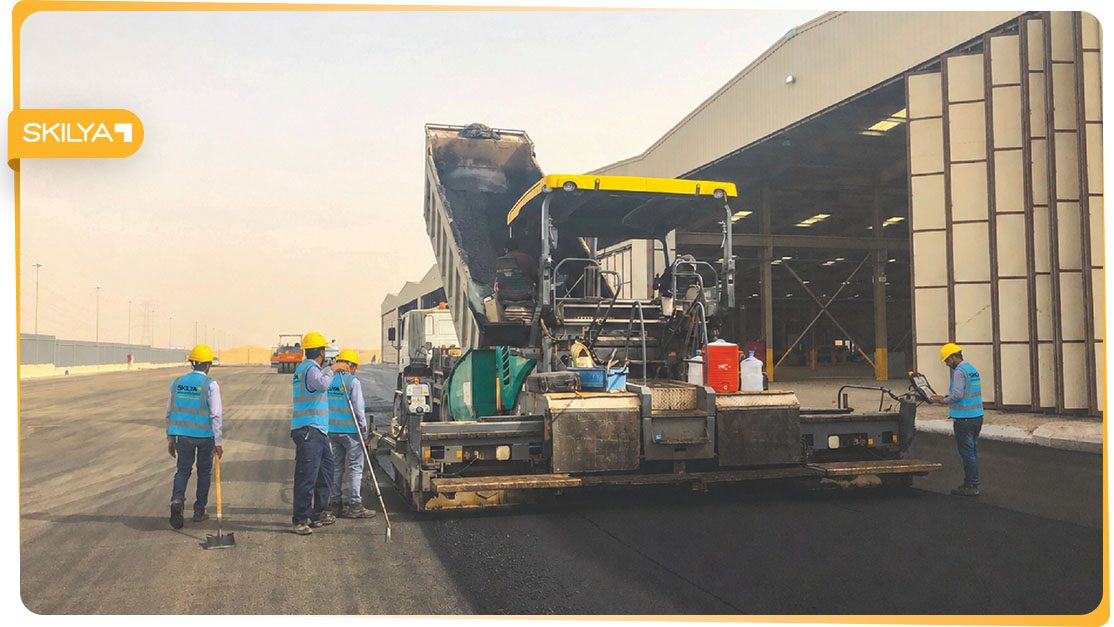
4. Asphalt Pavement Construction
Asphalt pavements are used for many road and circulation applications.
Depending on the design, road construction may include asphalt base, binder, and wearing courses.
The quotation should identify:
- Asphalt mixture specifications.
- Layer thicknesses.
- Surface preparation.
- Placement methods.
- Compaction requirements.
- Material testing.
- Finished surface tolerances.
The specific asphalt system must be selected according to the engineering design and operational conditions.
5. Concrete Pavement Construction
Certain industrial areas may use concrete pavements, particularly where the design calls for rigid pavement performance.
Concrete road construction may involve:
- Subgrade and base preparation.
- Concrete placement.
- Reinforcement or load-transfer components where designed.
- Joint construction.
- Finishing.
- Curing.
- Quality testing.
The required concrete mix, pavement thickness, joints, and reinforcement should be established through the approved design.
6. Road Drainage
Road drainage is important because accumulated water can affect traffic safety and pavement performance.
Depending on the design, installations may include:
- Surface slopes.
- Drainage channels.
- Catch basins.
- Stormwater inlets.
- Underground drainage connections.
- Other approved drainage structures.
The responsible party for drainage construction should be clearly identified in the contract.
7. Curbs, Pavement Edges, and Road Accessories
Industrial roadworks may include curbs, edging, paved shoulders, pedestrian interfaces, and other accessories.
These items should be specified separately where they form part of the project.
8. Road Markings and Traffic Management
Depending on the operational layout, the project may require road markings, signs, directional arrangements, speed-control features, and pedestrian separation.
Their installation should reflect the approved traffic management design.
What Technical Requirements Should Be Considered Before Road Construction?
Industrial road construction should begin with an understanding of how the completed site will operate.
Expected Traffic and Vehicle Types
Identify the vehicles expected to use the road, including heavy trucks, delivery vehicles, passenger cars, and specialized industrial transport.
Axle Loads and Traffic Frequency
Pavement design should reflect the expected loading conditions throughout the intended design period.
Vehicle Turning and Circulation
Truck turning paths, junction arrangements, loading bay access, and internal circulation influence the road layout.
Subgrade and Ground Conditions
Geotechnical information helps determine the suitability of existing soils and the need for ground preparation.
Drainage and Surface Levels
The road design must coordinate finished levels, drainage slopes, building entrances, and neighboring infrastructure.
Underground Utilities
Water networks, drainage pipes, electrical services, and communications may cross beneath roads.
Utility installations should be coordinated before pavement construction to reduce unnecessary excavation of completed surfaces.
Operational and Construction Access
Projects inside active industrial facilities may require phased construction, temporary access arrangements, or restricted work periods.
What Should Your Industrial Road Construction RFQ Include?
A detailed RFQ allows contractors to prepare technical and commercial proposals against consistent requirements.
1. Project Overview
Provide the project name, location, industrial activity, approximate site area, and expected construction schedule.
Explain whether the roadworks form part of a new industrial development or an existing facility expansion.
2. Road Layout and Engineering Drawings
Include available:
- Road layout drawings.
- Horizontal alignments.
- Longitudinal profiles.
- Cross-sections.
- Proposed finished levels.
- Junction details.
- Access arrangements.
- Road marking plans where relevant.
3. Pavement Design and Specifications
Identify whether the project uses asphalt, concrete, or different pavement types in designated areas.
Provide approved layer thicknesses, material specifications, design requirements, and acceptance criteria.
4. Geotechnical Information
Share available soil reports and relevant pavement-support investigations.
Clarify any required improvement or replacement of unsuitable material.
5. Traffic Loading Information
Provide the expected vehicle types, traffic frequencies, and relevant loading assumptions used in the pavement design.
6. Road Construction BOQ
An itemized BOQ may include:
- Clearing.
- Excavation.
- Backfilling.
- Imported fill.
- Subgrade preparation.
- Granular subbase.
- Aggregate base.
- Asphalt paving.
- Concrete paving.
- Curbs.
- Drainage structures.
- Road markings.
- Testing.
7. Underground Utility and Drainage Information
Identify existing and proposed utilities, drainage connections, and interfaces with other contractors.
8. Construction Schedule and Site Access
Provide planned commencement dates, installation milestones, working restrictions, and required handover dates.
9. Testing and Quality Requirements
Specify the inspections and tests required by the approved design and applicable specifications.
10. Commercial Requirements
Define the pricing format, payment terms, quotation validity, proposed measurement rules, exclusions, and variation procedures.
Industrial Road Construction RFQ Checklist
RFQ Requirement | Information to Provide |
Project Overview | Industrial site type, location, and development stage |
Road Drawings | Layouts, profiles, sections, and levels |
Traffic Requirements | Vehicle types, frequency, and design loading |
Pavement Specifications | Asphalt or concrete layers and materials |
Geotechnical Report | Subgrade and ground conditions |
BOQ | Quantities, work descriptions, and units |
Earthworks | Excavation, filling, grading, and compaction |
Drainage | Surface and underground drainage requirements |
Utilities | Existing and proposed service crossings |
Road Accessories | Curbs, markings, signs, and other specified items |
Testing | Material, compaction, pavement, and acceptance testing |
Schedule | Construction milestones and handover |
Commercial Terms | Rates, exclusions, payment, and validity |
A clear RFQ reduces assumptions and makes competing road construction quotations easier to compare.
Have industrial road drawings and a BOQ ready? Contact Skilya to discuss your roadworks and request a quotation.