

- seo
- October 26, 2026
Construction Contractor for Industrial Projects in Dammam: What to Include in Your RFQ
Finding the right industrial construction contractor in Dammam is one of the most important decisions when planning a factory, warehouse, manufacturing facility, or industrial development in Saudi Arabia.
Industrial construction projects involve more than conventional building works. They require careful coordination between structural systems, mechanical and electrical installations, industrial infrastructure, production requirements, safety considerations, and project schedules.
For industrial investors and project owners, selecting a contractor begins with preparing a clear Request for Quotation (RFQ).
A well-structured RFQ helps construction companies understand your requirements, assess the proposed scope of work, and prepare quotations that can be evaluated consistently.
Whether you are developing a new manufacturing facility in Dammam Second Industrial City, constructing a warehouse, or expanding an existing factory, preparing accurate project information can improve the contractor selection process.
In this guide, we explain what to include in an industrial construction RFQ, how to evaluate contractors, and how Skilya Construction Company can support industrial construction projects in Dammam and the Eastern Province.
Planning an industrial construction project in Dammam? Contact Skilya to discuss your requirements and submit your available project documents for review.
What Is an Industrial Construction RFQ?
An industrial construction RFQ, or Request for Quotation, is a formal document used by project owners to request pricing and commercial proposals from qualified construction contractors.
It defines the project’s requirements, scope of work, technical specifications, expected schedule, and commercial expectations.
Unlike a general construction inquiry, an industrial RFQ often includes specialized technical information related to manufacturing operations, equipment installation, utilities, structural loading, and industrial safety.
For example, a factory construction RFQ may include requirements for:
- Industrial building construction and civil works.
- Structural steel fabrication and installation.
- Production area foundations and industrial flooring.
- Electrical distribution and power requirements.
- HVAC, ventilation, and plumbing systems.
- Fire protection and fire alarm systems.
- Equipment foundations and machinery installation interfaces.
- Roads, drainage, and external infrastructure.
- Construction scheduling and project handover.
The objective is to give contractors enough information to understand the proposed project and prepare a commercially meaningful quotation.
Why Choosing the Right Industrial Construction Contractor in Dammam Matters
Dammam is an important industrial and logistics center in Saudi Arabia, with manufacturing facilities, warehouses, commercial developments, and supporting infrastructure.
Industrial construction projects in this environment may involve specialized requirements that differ significantly from ordinary residential or commercial buildings.
Understanding Industrial Building Requirements
Factories and industrial facilities must support production operations, equipment movement, material handling, storage, and employee safety.
The contractor needs to understand how building construction interacts with these operational requirements.
For example, a warehouse may require large structural spans, loading bays, industrial flooring, and efficient truck access.
A manufacturing facility may require equipment foundations, electrical capacity, ventilation systems, and specialized utility connections.
Coordinating Multiple Construction Disciplines
Industrial projects usually involve several interconnected construction activities.
Civil works, structural steel, MEP systems, fire protection, finishing works, and infrastructure must be coordinated throughout the project.
Working with an experienced general contracting company in Saudi Arabia can help simplify coordination and improve consistency across project activities.
Managing Construction Schedules
Industrial developments are frequently connected to business expansion plans and operational deadlines.
Delays in construction may affect equipment installation, commissioning, and the planned start of production.
A contractor with relevant industrial experience can help identify project dependencies and develop an appropriate execution schedule.
Supporting Long-Term Facility Performance
Industrial construction quality directly influences building durability, maintenance needs, and operational efficiency.
Selecting suitable structural systems, construction materials, and building services is therefore an important part of the contractor evaluation process.
What Should You Include in an Industrial Construction RFQ?
Preparing a complete RFQ allows contractors to evaluate your project with greater accuracy.
The following sections should form the foundation of an industrial construction request.
1. Project Overview and General Information
Start your RFQ with a clear description of the proposed industrial development.
Include basic information such as:
- Project name.
- Company or project owner.
- Project location in Dammam or the Eastern Province.
- Type of industrial facility.
- Approximate site area.
- Estimated building area.
- Current project development stage.
- Expected construction start date.
You should also identify whether the project is a new development, an extension to an existing facility, or a renovation involving operational areas.
This information helps the contractor understand the project’s overall objectives before reviewing detailed technical documents.
2. Detailed Scope of Construction Work
The scope of work is one of the most important sections of an industrial RFQ.
It defines the construction activities the contractor will be responsible for delivering.
Depending on your project, the scope may include:
Civil and Structural Works
Site preparation, excavation, backfilling, foundations, reinforced concrete, structural steel, and industrial floors.
Mechanical and Electrical Works
Electrical installations, lighting, HVAC, plumbing, ventilation, and associated building services.
Industrial Infrastructure
Internal roads, drainage, utility networks, external works, and site access.
Finishing and Supporting Facilities
Administrative offices, employee facilities, operational support spaces, and architectural finishes.
Clearly identify any work that will be performed by separate contractors or equipment suppliers to avoid overlapping responsibilities.
3. Architectural and Engineering Drawings
Industrial construction contractors need appropriate technical drawings to understand project dimensions, structural arrangements, building systems, and design requirements.
Your RFQ package may include:
- Architectural drawings.
- Structural drawings.
- Civil and infrastructure drawings.
- Mechanical drawings.
- Electrical drawings.
- Plumbing layouts.
- Fire protection drawings.
- Equipment layouts.
- Site development plans.
Where possible, identify drawing numbers, issue dates, and revision statuses.
This helps ensure that all contractors prepare quotations using the same technical information.
4. Bill of Quantities (BOQ)
A Bill of Quantities provides a structured breakdown of construction work items and their estimated quantities.
For industrial construction projects, the BOQ may contain:
- Excavation and earthworks.
- Reinforced concrete quantities.
- Structural steel quantities.
- Industrial flooring.
- Building envelope systems.
- Electrical installations.
- HVAC and plumbing.
- Fire protection.
- External infrastructure.
Providing a clear BOQ helps contractors prepare itemized quotations and allows procurement teams to compare proposals more consistently.
If your BOQ is incomplete, explain which quantities require verification or additional measurement.
5. Industrial Equipment and Operational Requirements
Unlike conventional building projects, industrial facilities must accommodate equipment and production processes.
Your RFQ should clearly communicate requirements related to machinery and operational activities.
These may include equipment weight, foundation loading, production line layouts, clear heights, overhead lifting equipment, material movement, vibration considerations, and maintenance access.
For a steel fabrication facility, for example, structural requirements may depend on the size of production equipment and the movement of heavy materials.
For a logistics warehouse, the building layout may prioritize storage capacity, racking systems, forklift movement, and loading operations.
Providing these requirements early helps the contractor understand the relationship between building construction and future operations.
6. Mechanical, Electrical, and Plumbing Requirements
MEP systems are essential for safe and reliable industrial operations.
Your RFQ should describe the required building services and any available engineering specifications.
Important considerations include:
Electrical Systems: Available supply, power demand, distribution arrangements, industrial lighting, backup systems where required, and equipment interfaces.
HVAC and Ventilation: Temperature control, ventilation requirements, internal environmental conditions, and equipment-related heat loads.
Plumbing and Drainage: Water supply, wastewater systems, sanitary facilities, and process-related drainage requirements.
Fire Protection: Fire alarm systems, firefighting infrastructure, and other fire safety measures appropriate to the facility.
The contractor should understand whether these systems are included in the construction scope or assigned to specialized contractors.
7. Project Location and Site Conditions
Site conditions can significantly influence construction costs, execution methods, and project duration.
Industrial project owners should provide available information about:
- Soil investigation results.
- Site levels and topography.
- Existing underground utilities.
- Site access arrangements.
- Groundwater conditions.
- Adjacent facilities.
- Available infrastructure connections.
- Relevant site restrictions.
For projects inside industrial cities, the RFQ should also identify applicable development conditions and approvals known to the project owner.
Contractors can then assess which construction activities may require additional coordination.
8. Project Timeline and Key Milestones
An industrial RFQ should identify the expected project schedule.
This includes the anticipated mobilization date, construction period, major milestones, and required handover date.
For projects involving production equipment, it may be necessary to coordinate building completion with machinery delivery and installation.
Important milestones may include:
- Site preparation completion.
- Foundation completion.
- Structural steel erection.
- Building envelope installation.
- MEP installation.
- Testing and commissioning.
- Final inspection and handover.
A realistic schedule should reflect project complexity, procurement requirements, and construction sequencing.
9. Quality, Safety, and Technical Requirements
Industrial facilities require consistent construction quality and appropriate safety management.
Your RFQ should describe any specific quality assurance, inspection, testing, and health and safety requirements.
Depending on the project, this may include material approvals, method statements, inspection and test plans, welding inspections, concrete testing, and documentation procedures.
Applicable Saudi requirements and project-specific standards should be identified in the contract documents.
10. Commercial Requirements and Quotation Format
The final section should explain how contractors are expected to submit their proposals.
Include:
- Quotation submission deadline.
- Pricing breakdown requirements.
- Currency and tax presentation.
- Payment terms.
- Quotation validity period.
- Expected construction schedule.
- Technical assumptions.
- Exclusions and clarifications.
- Warranty and defect liability requirements, where applicable.
- Required supporting documents.
A consistent submission format helps procurement teams compare commercial proposals more effectively.
Industrial Construction RFQ Checklist for Project Owners
Before sending your RFQ to an industrial construction contractor in Dammam, use the following checklist to confirm that your request includes the essential information.
How to Compare Industrial Construction Contractors in Dammam
Once you receive quotations from different contractors, the next step is evaluating their technical and commercial suitability.
An effective contractor selection process should examine more than the total project price.
Relevant Industrial Construction Experience
Look for contractors with experience delivering facilities similar to your proposed development.
A contractor experienced in warehouses, manufacturing facilities, and industrial buildings may be better prepared to understand specific operational requirements.
Reviewing completed projects can provide useful information about construction scope, project complexity, and execution capabilities.
Technical and Multidisciplinary Capabilities
Industrial construction often requires coordination between civil engineers, structural specialists, MEP contractors, steel fabrication teams, and infrastructure personnel.
Assess whether the contractor can manage these interfaces and clearly define its responsibilities.
Quality of the Technical Proposal
A strong technical proposal should demonstrate that the contractor understands the project.
Evaluate construction methodologies, proposed materials, execution sequences, quality procedures, and identified project risks.
Transparency of Commercial Pricing
Compare quotations based on identical project requirements.
Pay attention to exclusions, provisional sums, material assumptions, and responsibilities for activities that may not be included in the base price.
Project Management and Communication
Ask contractors how they intend to manage scheduling, reporting, technical approvals, site supervision, and coordination with the client.
Clear communication and structured project management can help reduce uncertainty throughout construction.
Why Choose Skilya as Your Industrial Construction Contractor in Dammam?
When searching for a reliable industrial construction contractor in Dammam, project owners should consider a company’s relevant experience, available construction capabilities, and understanding of industrial project requirements.
Established in 2016, Skilya Construction Company provides construction and contracting services in Saudi Arabia, with operations in Dammam and Al-Khobar.
Skilya supports different types of industrial and commercial developments through integrated construction capabilities covering general contracting, structural steel, MEP installations, finishing works, and infrastructure.
Integrated Industrial Construction Services
Skilya’s construction capabilities include:
- General Contracting: Civil construction, building works, project coordination, and execution.
- Structural Steel: Steel fabrication, steel structure installation, and related construction activities.
- MEP Services: Electrical, mechanical, plumbing, HVAC, and building systems.
- Infrastructure Works: Earthworks, site preparation, internal roads, and utility-related construction.
- Finishing Works: Architectural finishing for industrial support facilities, offices, and other building areas.
This multidisciplinary experience allows Skilya to support industrial projects that require coordination between several construction packages.
Proven Industrial Project Experience in Dammam
Skilya’s portfolio includes industrial facilities and warehouses in Dammam, providing project owners with examples of its relevant experience.
Dammam Second Industrial City
Skilya served as general contractor for a 13,700-square-meter warehouse project involving site preparation, steel erection, concrete construction, MEP installations, fire protection, and finishing works.
Zurwat Elmajed Steel Fabrication Factory
Dammam Third Industrial City
Skilya’s portfolio identifies the company as general contractor for this industrial steel fabrication facility.
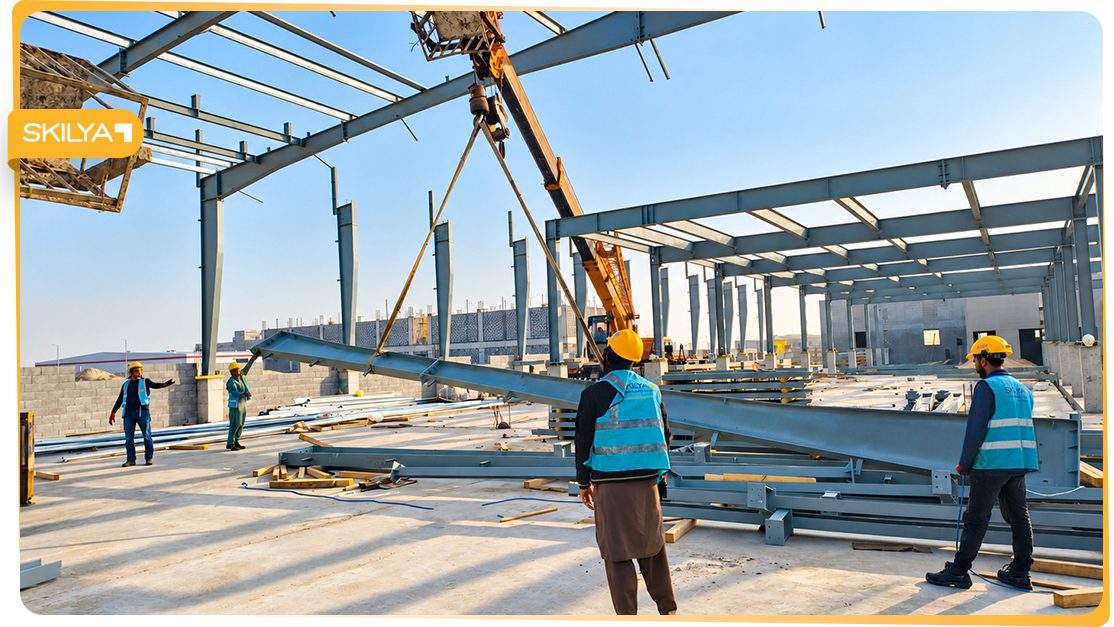
The images above are illustrative industrial construction references, not verified photographs of these Skilya projects.
Skilya has also reported the completion and handover of the United Stars Factory, reflecting continued collaboration with an industrial client.
These examples demonstrate why relevant project experience matters when choosing a contractor for industrial construction.
Explore more completed developments in the Skilya Projects Portfolio.
How to Submit Your Industrial Construction RFQ to Skilya
If you are planning a factory, warehouse, or industrial development in Dammam, the next step is to communicate your construction requirements.
Start by preparing a brief project description that identifies the type of facility, its location, approximate building area, expected timeline, and available technical documents.
You do not necessarily need to have every engineering document finalized before making an initial inquiry.
However, detailed quotations generally require sufficiently developed drawings, specifications, quantities, and scope definitions.
When contacting Skilya, you can outline your requirements and ask the team to review whether the project fits its construction capabilities.
Frequently Asked Questions About Industrial Construction RFQs in Dammam
What should an industrial construction RFQ include?
An industrial construction RFQ should include the project overview, location, scope of work, engineering drawings, BOQ, technical specifications, equipment requirements, construction timeline, site conditions, and commercial submission requirements.
How do I find an industrial construction contractor in Dammam?
Look for contractors with relevant experience in factories, warehouses, industrial buildings, and infrastructure. Review their completed projects, technical capabilities, proposed execution approach, and commercial terms before selecting a contractor.
Can I request an industrial construction quotation without a BOQ?
You can request an initial consultation without a completed BOQ. However, detailed pricing may require additional technical information, drawings, specifications, and quantities.
What is the difference between an RFQ and an RFP in construction?
An RFQ focuses primarily on obtaining pricing for a defined scope of work. An RFP, or Request for Proposal, can involve broader evaluation of technical solutions, construction methodology, project management approaches, and commercial proposals. The appropriate format depends on project complexity and procurement strategy.
Does Skilya handle factory and warehouse construction projects?
Yes. Skilya’s published project portfolio includes industrial factories and warehouses in Saudi Arabia, including developments in Dammam Second and Third Industrial Cities.
Can Skilya support projects involving steel structures and MEP systems?
Skilya provides structural steel and MEP-related construction services as part of its multidisciplinary capabilities. The specific scope available for a proposed project should be confirmed during the RFQ review.
Conclusion
Selecting the right industrial construction contractor in Dammam begins with a clear understanding of your project’s technical requirements, operational objectives, and commercial expectations.
A well-prepared RFQ helps contractors assess the construction scope, identify potential challenges, and submit proposals that can be compared effectively.
For industrial project owners, including accurate drawings, BOQ information, equipment requirements, site conditions, and construction schedules can significantly improve the quotation process.
With experience in factory construction, warehouses, structural steel, MEP systems, and integrated contracting services, Skilya Construction Company is a potential construction partner for industrial developments in Dammam and the Eastern Province.
Have an industrial project ready for discussion? Contact Skilya to share your requirements and take the next step toward your construction quotation.