

- seo
- October 1, 2026
Skilya Projects: Industrial and Commercial Construction Portfolio
Construction experience is best demonstrated through completed and ongoing projects.
Services, equipment, technical capabilities, and engineering knowledge are important, but a construction portfolio shows how those capabilities are applied to real buildings with different functions, technical requirements, site conditions, and client objectives.
Skilya Projects include industrial facilities, factories, warehouses, administrative buildings, steel structures, commercial developments, and other construction environments across Saudi Arabia.
This diverse construction portfolio reflects the multidisciplinary nature of Skilya’s work. Some projects require extensive civil construction and general contracting. Others place greater emphasis on structural steel, MEP coordination, industrial infrastructure, warehouse functionality, commercial spaces, or specialized project requirements.
Together, these projects demonstrate how Skilya adapts construction solutions according to the purpose of each facility.
Why a Construction Portfolio Matters
Choosing a construction contractor involves more than reviewing a list of services.
Project owners need to understand whether the contractor has experience with buildings similar to the one they plan to develop.
An industrial project may require experience with:
- Factories
- Warehouses
- Production facilities
- Heavy utilities
- Structural steel
- Industrial MEP systems
- Loading and logistics areas
A commercial project can introduce a different combination of requirements, including:
- Customer-facing spaces
- Administrative facilities
- Showrooms
- Retail environments
- Architectural steel
- Interior finishing
- Building services
- External areas
A varied construction portfolio therefore provides useful evidence of how a contractor approaches different types of projects.
Skilya Construction Projects in Saudi Arabia
Skilya’s project portfolio includes developments across several sectors and construction scopes.
Among the projects represented in the portfolio are:
- Rawabi Electric Factory
- United Stars DG Warehouses
- SABIC Admin Building
- Al-Hayah Downtown
- Al-Hayah Walk
- Zurwat Elmajed Steel Fabrication Factory
- Al-Qahtani Beverages Warehouse
- Lora Fiberglass Factory
- Mass Vision Factory
- S4 Showroom
- Bayfront Complex
- Other industrial and commercial developments
These projects involve different building types, clients, locations, and scopes.
This variety is important because construction methods need to respond to the operational purpose of each project.
A warehouse cannot be planned in the same way as a commercial destination.
A manufacturing facility has different technical priorities from an administrative building.
The contractor therefore needs to understand the relationship between construction and the future use of the facility.
Skilya Industrial Construction Portfolio
Industrial construction represents an important part of Skilya’s project experience.
Factories and industrial facilities are technically demanding because the building needs to support an operation rather than simply provide usable floor area.
A typical industrial facility may need to coordinate:
- Production equipment
- Warehousing
- Structural systems
- Electrical loads
- HVAC
- Plumbing
- Fire protection
- Utility networks
- Service areas
- Loading facilities
- Internal logistics
- External roads
The construction team therefore needs to understand how the facility will function after handover.
Skilya’s industrial portfolio includes factory, warehouse, and specialized industrial projects that demonstrate experience across these requirements.
Rawabi Electric Factory
Rawabi Electric Factory represents one of the major industrial projects within the Skilya portfolio.
Factory projects need to coordinate the production environment with administrative, storage, technical, and service requirements.
Unlike conventional buildings, industrial facilities may contain multiple operational zones that need to function together.
Construction can therefore involve coordination between:
- Production areas
- Warehouses
- Administrative spaces
- Utility systems
- Electrical infrastructure
- HVAC
- Fire protection
- Plumbing
- External site works
Projects of this nature demonstrate how industrial construction involves much more than completing the building structure.
The contractor needs to understand the relationship between the facility and the industrial processes it is expected to support.
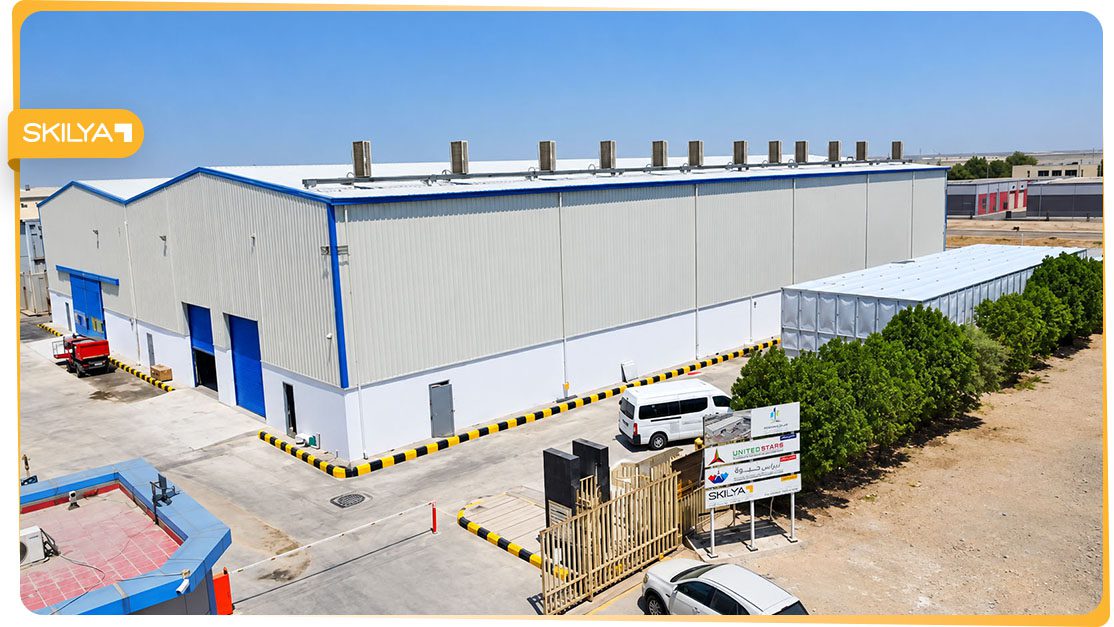
United Stars DG Warehouses
Warehouses form another important part of Skilya’s industrial project portfolio.
United Stars DG Warehouses demonstrates the multidisciplinary requirements associated with modern warehouse construction.
Warehouse facilities depend heavily on coordination between the building structure and logistics operations.
Important elements can include:
- Large structural spaces
- Industrial flooring
- Storage layouts
- Vehicle access
- Loading areas
- Electrical systems
- HVAC
- Plumbing
- Fire protection
- External site works
For logistics-oriented facilities, construction quality directly influences future operations.
The building needs to allow materials, employees, forklifts, trucks, and services to move efficiently through the property.
Projects like United Stars help demonstrate Skilya’s experience in coordinating warehouse structures with the technical systems required to operate them.
Zurwat Elmajed Steel Fabrication Factory
Zurwat Elmajed Steel Fabrication Factory adds another dimension to Skilya’s industrial construction experience.
Steel fabrication facilities need to support manufacturing processes that can involve heavy materials, production equipment, machinery movement, storage areas, and large internal working spaces.
This type of project can require close coordination between:
- Structural construction
- Production areas
- Industrial utilities
- Equipment layouts
- Material movement
- Internal access
- External infrastructure
Construction decisions therefore need to reflect how steel moves through the facility from raw material to finished component.
Experience with specialized industrial environments can help contractors understand how building construction interacts with manufacturing operations.
Lora Fiberglass Factory
Lora Fiberglass Factory is another example of Skilya’s factory construction experience.
Manufacturing facilities often combine production, technical, administrative, storage, and service areas within one project.
These facilities can require different environmental and technical conditions depending on the manufacturing process.
The contractor therefore needs to coordinate conventional construction with operational requirements.
Factory construction can involve decisions related to ventilation, utilities, electrical distribution, industrial flooring, structural requirements, safety systems, and equipment access.
Every manufacturing project introduces different challenges, making adaptability an important capability for industrial contractors.
Al-Qahtani Beverages Warehouse
The Al-Qahtani Beverages Warehouse adds further warehouse experience to the Skilya construction portfolio.
Storage facilities need to be developed around how products are received, stored, moved, and dispatched.
Important warehouse construction considerations can include:
- Storage capacity
- Racking requirements
- Clear height
- Internal circulation
- Industrial flooring
- Loading access
- Fire protection
- Electrical systems
- External logistics areas
A beverage warehouse may also introduce operational requirements connected with product handling and storage conditions.
This reinforces the importance of planning the warehouse around the operation instead of simply constructing an empty building.
Mass Vision Factory
The Mass Vision Factory represents another industrial project within Skilya’s growing portfolio.
Each new factory adds different technical and operational requirements.
Industrial construction teams need to adapt project planning according to the client’s production needs, building systems, structural strategy, infrastructure, site conditions, and schedule.
A diverse factory portfolio strengthens the contractor’s understanding of how construction methods need to change between different industrial environments.
What Industrial Projects Demonstrate About Construction Capability
Industrial construction experience can provide evidence across several important contractor capabilities.
Multidisciplinary Coordination
Factories and warehouses frequently involve civil, structural, MEP, infrastructure, and finishing packages operating within the same project.
Technical Execution
Industrial projects can contain equipment, utilities, heavy loads, specialized systems, and demanding construction interfaces.
Site Logistics
Construction equipment, deliveries, materials, subcontractors, and industrial operations all need to be coordinated.
Project Management
Factory and warehouse schedules often connect directly with business operations.
Delays can affect production launches, inventory transfers, and commercial commitments.
Operational Understanding
The building ultimately needs to support the client’s industrial process.
These requirements make industrial construction a strong test of contractor coordination.
Skilya Commercial Construction Portfolio
Commercial projects introduce a different construction environment.
The completed facility may serve customers, employees, visitors, businesses, tenants, or the public.
Technical performance still matters, but the project may also place greater emphasis on:
- Architecture
- Interior environments
- Public circulation
- Accessibility
- Façades
- Finishing
- Lighting
- Customer experience
- Building services
Skilya’s portfolio includes commercial and administrative projects that complement its industrial construction experience.
SABIC Admin Building
The SABIC Admin Building demonstrates Skilya’s experience with administrative construction and structural steel work.
Administrative buildings require a combination of structural performance and functional interior environments.
Office and administrative spaces need to accommodate employees, meeting areas, building services, communication systems, lighting, HVAC, circulation, and architectural requirements.
Skilya’s published project scope for the SABIC Admin Building includes steel structure building work covering design, fabrication, erection, and civil work.
Projects combining engineering, fabrication, erection, and civil construction require close technical coordination between the structural system and the wider building.
Al-Hayah Downtown
Al-Hayah Downtown represents another commercial development within the Skilya portfolio.
Commercial developments need to balance technical construction with the experience of future users.
Retail and destination projects may involve:
- Public circulation
- Commercial units
- Gathering areas
- Interior and exterior finishing
- Lighting
- Building services
- Parking
- Landscaping
- Access
These projects can be particularly coordination-intensive because structural, architectural, and MEP requirements all influence the final commercial environment.
Construction therefore needs to protect both technical performance and architectural intent.
Al-Hayah Walk
Al-Hayah Walk further expands Skilya’s experience across commercial and leisure-focused construction environments.
Projects designed around shopping, dining, entertainment, and public activity depend heavily on user movement.
Entrances, pedestrian areas, parking, commercial spaces, public zones, landscaping, and service routes all need to function together.
Commercial projects also tend to place a greater visual emphasis on structural details and finishing compared with many industrial facilities.
This makes coordination between engineering and architecture particularly important.
Bayfront Complex
Bayfront Complex demonstrates Skilya’s involvement in a commercial and leisure-oriented waterfront development.
For this type of project, structural construction needs to support a wider architectural and public-use environment.
Commercial destination projects may contain restaurants, retail areas, event spaces, public facilities, landscaping, and other visitor-focused features.
Steel structure work within these environments often needs to meet engineering requirements while supporting the architectural identity of the development.
This demonstrates a different application of structural steel compared with its use in factories and warehouses.
S4 Showroom
S4 Showroom adds showroom construction to the wider project mix.
Showrooms can have specific requirements related to:
- Open internal space
- Customer visibility
- Building appearance
- Lighting
- Structural layouts
- Entrances
- Display areas
The structure needs to support a commercial environment where the building itself can form part of the customer’s experience.
Experience across showrooms, commercial destinations, administrative buildings, and industrial facilities demonstrates the range of project environments a multidisciplinary contractor may need to manage.
Industrial vs. Commercial Construction Projects
Industrial and commercial projects share many core construction activities, but their priorities can differ significantly.
Industrial facilities may prioritize:
- Production
- Storage
- Heavy utilities
- Structural efficiency
- Equipment integration
- Logistics
- Future expansion
- Commercial projects may prioritize:
- Customer experience
- Architecture
- Public circulation
- Interior finishing
- Comfort
- Accessibility
- Building appearance
For a construction company working across both sectors, the important capability is adaptability.
Construction methods should respond to what the completed facility needs to achieve.
Structural Steel Across the Skilya Portfolio
Structural steel appears across several types of projects in the Skilya portfolio.
Industrial buildings may use steel to create large spans for production or storage.
Commercial developments can use structural steel to support wide public areas, architectural elements, roofs, or other building features.
Administrative facilities may combine steel structures with office environments.
Successful delivery requires coordination between design, fabrication, foundations, steel erection, MEP installations, roofing, and architectural work.
This is why structural steel experience can strengthen both industrial and commercial project delivery.
General Contracting Across Different Projects
Many construction projects require one contractor to coordinate multiple packages.
General contracting can include responsibility for:
- Civil works
- Structural systems
- MEP
- Site development
- Subcontractors
- Procurement
- Quality
- Scheduling
- Finishing
- Handover
Skilya’s portfolio includes projects where the company has served as main or general contractor as well as projects involving specialized steel-structure scopes.
This mixture strengthens the portfolio because it demonstrates experience both in complete project coordination and specialized technical packages.
Project Management From Planning to Handover
A strong construction portfolio should demonstrate more than physical buildings.
It should also reflect the contractor’s ability to manage the construction process.
Project delivery can include:
- Understanding scope
- Reviewing technical information
- Site assessment
- Cost and quantity evaluation
- Scheduling
- Procurement
- Mobilization
- Construction execution
- Quality management
- Testing
- Closeout
- Final handover
- Each stage influences the next.
Industrial and commercial projects can contain dozens of overlapping activities, making project-management capability particularly important.
Repeat Clients and Long-Term Relationships
One useful indicator within a construction portfolio is repeat work.
A client returning for another project can demonstrate an established working relationship and familiarity between the contractor and client teams.
Skilya’s relationship with United Stars is one example, with the company reporting a second successful collaboration and handover of a United Stars factory project.
Repeat collaboration is particularly valuable in construction because both teams develop a better understanding of technical expectations, communication processes, and project requirements.
What Skilya’s Construction Portfolio Shows
Viewed as a whole, the Skilya construction portfolio demonstrates experience across several different construction environments.
It includes:
- Factory construction
- Warehouse projects
- Steel fabrication facilities
- Administrative buildings
- Steel structures
- Commercial developments
- Showrooms
- Logistics-related facilities
This range supports an important principle: construction capability is not defined by how many services a contractor lists, but by the ability to combine those services successfully within real projects.
Connecting Services With Real Construction Projects
Skilya’s wider service offering includes construction, structural steel, MEP, infrastructure, finishing works, interior design, steel fabrication, and general contracting.
The project portfolio provides context for those services.
Structural steel becomes more meaningful when connected with factories, warehouses, administrative buildings, and commercial developments.
MEP capability can be demonstrated through facilities that require electrical, plumbing, HVAC, and fire systems.
General contracting experience becomes visible through projects requiring coordination between multiple disciplines.
A well-developed portfolio therefore creates the connection between what a construction company says it can provide and the environments in which those capabilities have been applied.
Skilya Projects and Construction Experience in Saudi Arabia
Skilya Projects provide a practical view of the company’s construction experience across Saudi Arabia.
Industrial developments such as factories and warehouses demonstrate experience with technically demanding operational facilities.
Commercial and administrative projects demonstrate the ability to coordinate engineering requirements with architecture, public spaces, building services, and finishing.
Steel-structure projects further demonstrate specialized experience that can support both industrial and commercial construction.
Together, these project types create a diversified construction portfolio that reflects Skilya’s multidisciplinary approach.
Clients considering a new industrial or commercial development can use the portfolio to explore projects relevant to their own requirements and understand how Skilya’s construction capabilities have been applied across different sectors.
Explore the Skilya Construction Portfolio
For project owners, developers, industrial companies, and businesses evaluating a construction partner, past work provides valuable context.
The Skilya industrial and commercial construction portfolio demonstrates project experience across factories, warehouses, steel structures, administrative facilities, commercial destinations, and specialized buildings.
Each project introduces a different combination of structural, technical, operational, architectural, and management requirements.
Together, they demonstrate how Skilya applies construction expertise according to the purpose of each development rather than using one standardized approach for every project.
Explore the full Skilya Projects portfolio to view individual projects, construction scopes, galleries, and further information about the company’s experience across Saudi Arabia.
Frequently Asked Questions
What types of projects are included in the Skilya portfolio?
Skilya’s portfolio includes factories, warehouses, steel structures, administrative buildings, commercial developments, showrooms, and other industrial and commercial construction projects.
Does Skilya have experience with industrial construction projects?
Yes. Skilya’s portfolio includes several factory, warehouse, manufacturing, and industrial facility projects.
What warehouse projects has Skilya worked on?
Skilya’s portfolio includes United Stars DG Warehouses and Al-Qahtani Beverages Warehouse, among other industrial developments.
Does Skilya work on commercial construction projects?
Yes. The portfolio includes commercial and administrative developments such as Al-Hayah Downtown, Al-Hayah Walk, Bayfront Complex, S4 Showroom, and SABIC Admin Building.
Does Skilya provide structural steel services on its projects?
Structural steel forms part of Skilya’s wider construction capabilities, and several projects within the portfolio involve steel structures, fabrication, erection, or related work.
Where can I view Skilya’s construction projects?
The Skilya Projects page presents the company’s project portfolio, with individual project pages providing further information and project galleries.
Why is a construction company’s project portfolio important?
A portfolio allows potential clients to evaluate the types of facilities a contractor has worked on and whether its previous experience is relevant to the requirements of a new project.
Does Skilya work as a general contractor?
Yes. Skilya’s portfolio includes projects delivered under main or general contractor scopes as well as projects involving specialized structural-steel work.