

- seo
- September 6, 2026
Anchor Bolt Installation for Steel Structures and Industrial Equipment
Anchor bolts may look like relatively small construction components, but their position and installation accuracy can determine whether structural steel columns, machinery, platforms, and industrial equipment can be installed correctly.
In industrial and structural steel projects, anchor bolts create the connection between concrete foundations and the elements installed above them.
If the bolts are misplaced, incorrectly leveled, insufficiently embedded, or damaged during concrete pouring, the problem may only become obvious when steel or equipment arrives on site.
At that point, correcting the issue can require drilling, cutting, redesign, fabrication changes, or even partial foundation modification.
For this reason, anchor bolt installation should be treated as a precision construction activity involving structural, civil, steel fabrication, survey, and equipment teams.
Good installation starts long before concrete is poured.
What Are Anchor Bolts in Construction?
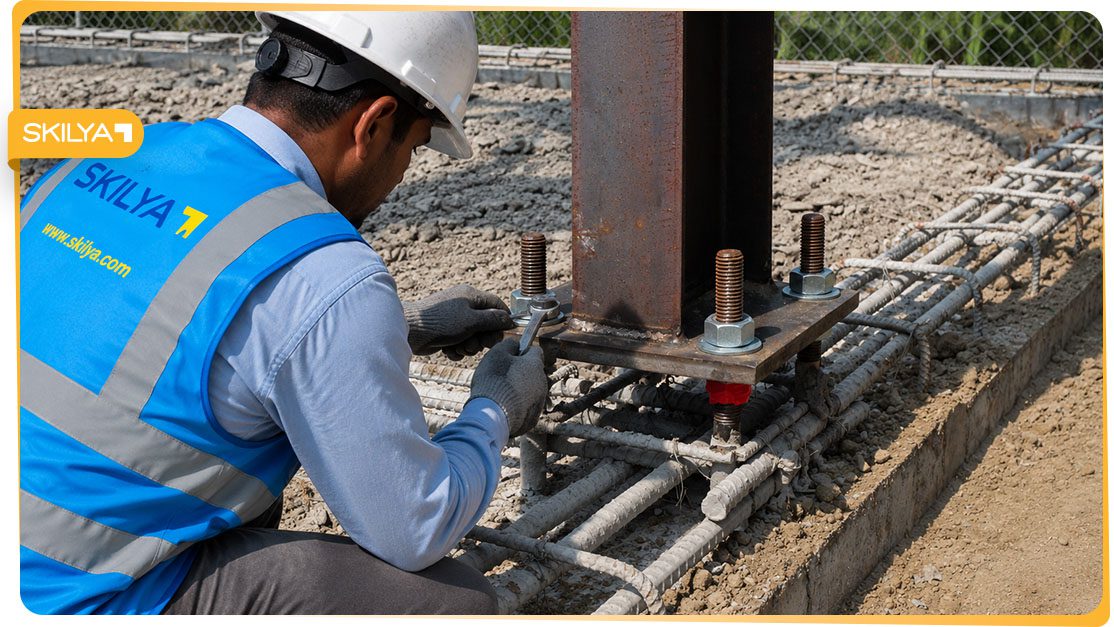
Anchor bolts are fasteners embedded in or fixed to concrete to connect structural or mechanical components to a foundation.
They are commonly used for:
- Structural steel columns
- Pre-engineered buildings
- Steel platforms
- Industrial machinery
- Pumps
- Generators
- Tanks
- Equipment skids
- Pipe supports
- Heavy mechanical equipment
The type and arrangement of anchor bolts depend on the structural design and equipment requirements.
Some bolts are cast directly into concrete, while others may be installed after concrete placement using approved post-installed anchoring systems.
For critical industrial and structural applications, the selected anchoring method should follow the approved project design.
Why Anchor Bolt Accuracy Matters
Anchor bolts form a direct interface between two different construction packages.
For example:
Concrete Foundation → Anchor Bolts → Base Plate → Steel Column
If one part of this sequence is incorrect, the next activity may not proceed as planned.
Typical problems caused by poor anchor bolt installation include:
- Steel columns not fitting base plates
- Machinery baseplates not aligning
- Incorrect column position
- Excessive modification of steel plates
- Construction delays
- Site welding or drilling
- Reduced installation tolerances
The earlier these issues are prevented, the easier steel erection and equipment installation become.
1. Start with the Latest Approved Drawings
Anchor bolt installation should never be based on an outdated drawing or preliminary layout.
The team should confirm the latest approved:
- Structural drawings
- Foundation drawings
- Steel shop drawings
- Equipment supplier drawings
- Anchor bolt plans
- Relevant RFIs
Revision control is extremely important.
A structural column location may change during design coordination, and even a small grid adjustment can affect every associated anchor bolt.
Before installation begins, the site team should confirm that all drawings refer to the same approved revision.
2. Verify the Exact Anchor Bolt Specification
Not all anchor bolts are the same.
The project documentation should define requirements such as:
- Diameter
- Length
- Material grade
- Thread length
- Embedment depth
- Washer size
- Nut type
- Corrosion protection
Using an incorrect bolt diameter or grade can create structural compliance problems even if the location is correct.
The installation team should compare delivered bolts against the approved material requirements before positioning them in the foundation.
3. Use an Anchor Bolt Template
One of the most effective ways to maintain bolt spacing is using an anchor bolt template.
A template holds the bolts in the required position while reinforcement, formwork, and concrete work are completed.
The template may control:
- Bolt spacing
- Orientation
- Projection
- Group alignment
For steel columns, the template should match the base plate hole pattern.
For machinery foundations, it should match the approved equipment anchor layout.
Templates should be sufficiently rigid to resist movement during concrete placement.
A flexible or poorly secured template can shift even after the survey team has confirmed the original position.
4. Survey the Bolt Group Before Concrete Pouring
Survey control is critical.
The bolt group should be checked against:
- Building grid lines
- Column centerlines
- Foundation coordinates
- Equipment centerlines
The survey team should not rely only on measurements from foundation edges.
Formwork itself may contain small dimensional deviations.
Using established project control points gives a more reliable position.
For important equipment or structural steel, both horizontal coordinates and vertical elevation should be confirmed before pouring.
5. Check Anchor Bolt Projection
The portion of the bolt extending above the concrete must be sufficient for the final connection.
This projection may need to accommodate:
- Base plate thickness
- Leveling nuts
- Washers
- Final nuts
- Grout gap
If the bolt projection is too short, the contractor may not have enough threaded length to complete the connection.
If it is excessively long, it may interfere with installation or require adjustment.
The required projection should therefore be verified against the final connection detail before concrete placement.
6. Coordinate Base Plate and Grout Requirements
Structural steel columns and equipment are often installed above a grout layer rather than directly on concrete.
The final arrangement may include:
Concrete Foundation → Leveling Arrangement → Grout → Base Plate → Washer and Nut
The construction team should understand:
- Required grout thickness
- Base plate elevation
- Nut position
- Bolt projection
- Finished foundation elevation
A mistake in any of these values can shift the final structural steel or equipment level.
7. Coordinate Anchor Bolts with Reinforcement
One of the most common site conflicts occurs between anchor bolts and reinforcement bars.
A large bolt may pass through a dense reinforcement cage.
Site teams should not simply cut reinforcement to make the bolt fit.
Instead, the conflict should be resolved through coordinated structural detailing.
Possible solutions may involve:
- Adjusting reinforcement spacing
- Modifying secondary reinforcement
- Revising local detailing
- Adjusting approved bolt arrangements where technically permitted
The structural engineer should approve any change affecting reinforcement or anchor positioning.
8. Protect the Threads During Concrete Work
Anchor bolt threads are vulnerable during construction.
Concrete, dirt, welding sparks, or impact can damage the threaded area.
Temporary protection can be used to keep threads clean during:
- Reinforcement works
- Concrete pouring
- Finishing
- Curing
Before steel or equipment installation, the contractor should check that:
- Threads are clean
- Nuts move correctly
- Bolts are not bent
- Protective coating remains acceptable
Damaged threads can create unnecessary installation delays.
9. Secure the Bolts Before Pouring
Correct survey positioning is not enough.
The anchor bolts must also remain in position while concrete is placed and vibrated.
The assembly should be secured to resist:
- Concrete pressure
- Worker movement
- Vibrator contact
- Reinforcement movement
The team should inspect both the bolt template and its temporary supports.
Any movement during concreting can shift the entire group.
10. Pour Concrete Carefully Around Anchor Bolt Assemblies
Concrete placement around bolt groups needs careful execution.
Dense reinforcement, templates, and embedded bolts can make concrete compaction more difficult.
The contractor should avoid:
- Directly striking the template with vibrators
- Moving bolts while placing concrete
- Leaving voids beneath templates
- Creating honeycombing around embedded areas
Concrete should be properly consolidated while protecting the anchor arrangement.
After placement, the bolt group should be visually checked for movement before the concrete begins to set.
11. Conduct a Post-Pour Survey
Anchor bolt control should not end once the concrete is poured.
After the foundation has gained sufficient strength, the contractor should survey the bolts again.
This survey can confirm:
- Final coordinates
- Bolt spacing
- Elevations
- Projection
- Group orientation
A post-pour survey identifies problems before structural steel or industrial equipment reaches the site.
That timing is important.
Discovering a bolt deviation early provides more time for technical evaluation and corrective planning.
Anchor Bolt Tolerances in Structural Steel Construction
Structural steel installation depends on alignment.
When anchor bolts fall outside acceptable installation tolerance, base plate holes may not align.
However, contractors should not automatically enlarge holes or modify steel members on site.
The deviation should first be measured and reviewed.
Depending on the situation, an approved corrective solution may involve:
- Base plate modification
- Engineering evaluation
- Approved adjustment of connection details
- Other engineered corrective measures
The correct solution depends on the structural design, magnitude of the deviation, and project requirements.
Uncontrolled site modification can affect the integrity of the final connection.
Anchor Bolts for Machinery Foundations
Machinery anchor bolts often require even greater coordination because machine installation may depend on precise equipment alignment.
Important information can include:
- Manufacturer bolt pattern
- Equipment centerline
- Foundation level
- Grout thickness
- Baseplate dimensions
- Maintenance orientation
- Utility connections
The foundation should be coordinated using the final approved equipment data.
If the machine has several connection points to a production line, even a small positioning error may affect downstream alignment.
Cast-In Anchor Bolts vs Post-Installed Anchors
Two broad approaches may be used depending on the design.
Cast-In Anchor Bolts
These are positioned before concrete placement and become embedded as the foundation is poured.
They are commonly used for:
- Major structural steel
- Heavy equipment
- Industrial foundations
Their main challenge is installation accuracy because the bolt position becomes difficult to change afterward.
Post-Installed Anchors
These are installed into hardened concrete after construction.
Depending on the design, they may use mechanical or chemical anchoring systems.
Post-installed anchors can provide flexibility for certain applications, but they should only be used where permitted by the structural design and approved project requirements.
The selection should be an engineering decision, not a site convenience decision.
Anchor Bolt Installation for Structural Steel Columns
Steel column installation typically follows a coordinated sequence:
- Foundation completed
- Anchor bolts surveyed
- Concrete reaches required strength
- Foundation top prepared
- Column delivered
- Column lifted
- Base plate positioned over bolts
- Column aligned and leveled
- Temporary stability provided
- Grouting completed
- Final connection secured
Accurate anchor bolts make this sequence much more efficient.
If bolt groups are poorly positioned, crane time and erection productivity can be lost while teams wait for corrective action.
Anchor Bolts and Pre-Engineered Buildings
PEB structures rely on repetitive structural grids.
Anchor bolt accuracy is particularly important because steel frames are fabricated before arriving on site.
The fabricated frame geometry cannot easily adapt to large foundation positioning errors.
A mistake in one foundation may affect:
- Column installation
- Frame alignment
- Roof members
- Wall cladding
- Future structural bays
Accurate survey control during civil works therefore supports faster steel erection later.
How Skilya Coordinates Anchor Bolt Installation with Structural Steel Works
At Skilya, anchor bolt installation can be coordinated as part of the wider relationship between civil construction, structural steel fabrication, and steel erection rather than treated as an isolated foundation activity.
Through its capabilities in general contracting, structural steel, steel fabrication, civil construction, and industrial project execution, Skilya can coordinate foundation information with the actual requirements of fabricated steel structures and industrial equipment.
For structural steel projects, this can include reviewing anchor bolt layouts against steel shop drawings and base plate configurations before concrete placement. Survey control, bolt projection, reinforcement interfaces, foundation levels, and erection requirements can then be considered within one coordinated sequence.
For industrial equipment, Skilya can also coordinate anchor bolt positioning with machinery foundations, equipment supplier information, surrounding structural steel, MEP connections, and future installation access.
This integrated approach is especially valuable because errors made during civil construction may only become visible much later during steel erection or machinery installation.
By connecting these disciplines through its general contracting services and structural steel capabilities, Skilya can help reduce interface errors between foundations and the elements installed above them, supporting smoother erection and more controlled industrial project execution.
Common Anchor Bolt Installation Mistakes
Using the Wrong Drawing Revision
Always confirm the latest approved layout.
Weak Bolt Templates
Templates should maintain bolt geometry during concrete placement.
Poor Survey Control
Bolt groups should be referenced to established project coordinates.
Ignoring Bolt Projection
The final connection needs enough usable thread length.
Cutting Reinforcement Without Approval
Structural conflicts must be resolved technically.
Failing to Protect Threads
Damaged or contaminated threads can delay erection.
Skipping the Post-Pour Survey
The final bolt position should be verified before steel or equipment delivery.
Anchor Bolt Installation Checklist
Before concrete placement, verify:
- Latest approved drawings are available
- Bolt diameter and grade are correct
- Bolt length is correct
- Embedment is verified
- Template matches required bolt pattern
- Group coordinates are surveyed
- Bolt elevations are confirmed
- Bolt projection is checked
- Reinforcement conflicts are resolved
- Bolts are properly secured
- Threads are protected
- Grout and base plate levels are considered
After concrete placement, verify:
- Bolt group position
- Spacing
- Elevation
- Projection
- Thread condition
- Orientation
- Any measurable deviations
Final Thoughts
Accurate anchor bolt installation is one of the key links between concrete construction and the structural steel or industrial equipment that follows.
A bolt group that is only slightly out of position can create consequences much larger than the cost of the bolts themselves.
Successful installation depends on coordination between:
Structural Design + Survey + Reinforcement + Base Plates + Steel Fabrication + Equipment Data + Concrete Works
By checking these interfaces before concrete pouring and verifying the final position afterward, project teams can reduce installation problems and avoid unnecessary site modifications.
For industrial construction and structural steel projects, precision at the foundation stage directly supports faster, safer, and more predictable erection later.